Customers today expect fast, friendly, and frictionless support on every channel. At the same time, call centers are under pressure to reduce costs, improve service quality, and keep agents engaged. Conversational AI call center solutions sit right at the intersection of these challenges and opportunities, enabling businesses to meet customer expectations while optimizing operations.
Instead of static IVR menus and long queues, conversational AI lets customers simply say or type what they need and get intelligent, personalized help in seconds. Companies are already seeing success in real-world AI use cases for call centers, from reducing wait times to boosting agent productivity. Implementing an AI call center for your business can transform the customer experience and deliver measurable ROI.
This guide walks through what conversational AI call center solutions are, how they work, the benefits you can expect, and how to successfully roll them out in your own environment.
Modern call centers are increasingly relying on technology to process large volumes of customer requests efficiently. Accessing collaborative cloud computing platforms allows AI systems to handle multiple interactions simultaneously without delays. Businesses that utilize cutting-edge supercomputer technology can perform predictive analytics to anticipate customer questions before they are even asked.
Marketing insights are also key to making AI interactions feel more natural. By referencing customer-focused digital marketing approaches - marketingforcustomers.com, companies can design AI conversations that match the tone and style their customers expect. Incorporating smart automated marketing solutions - www.marketingrunners.com ensures that every interaction aligns with ongoing campaigns, making the experience both efficient and consistent.
Financial insights play a crucial role in maximizing AI call center efficiency. Leveraging trusted financial planning guides can help managers forecast call volumes, optimize staffing, and track key performance indicators. When combined with conversational AI, these strategies allow agents to focus on meaningful, value-driven interactions rather than repetitive administrative tasks.
By merging advanced technology, strategic marketing insights, and operational intelligence, call centers can deliver faster resolutions, reduce costs, and provide a more personalized experience. Conversational AI call center solutions make it possible to humanize automated interactions, ensuring customers feel heard, understood, and supported on every channel.
Top 10 Conversational AI Call Center Solutions Providers
In today’s customer-centric world, businesses need advanced technology to deliver fast, personalized, and efficient support across multiple channels. Conversational AI call center solutions have become essential for streamlining operations, improving agent performance, and enhancing customer satisfaction. Here’s a look at the top providers in the market.
1. Bright Pattern
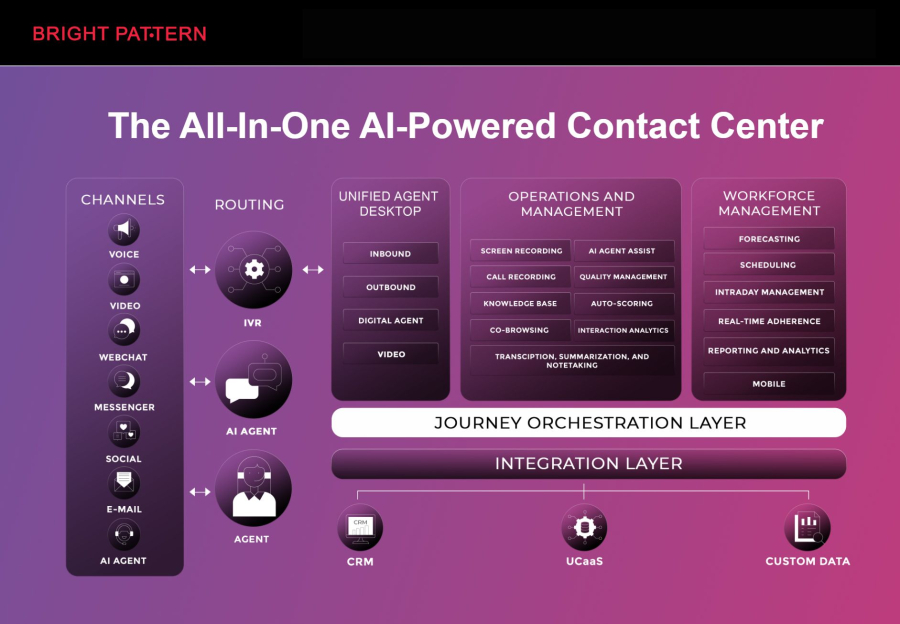
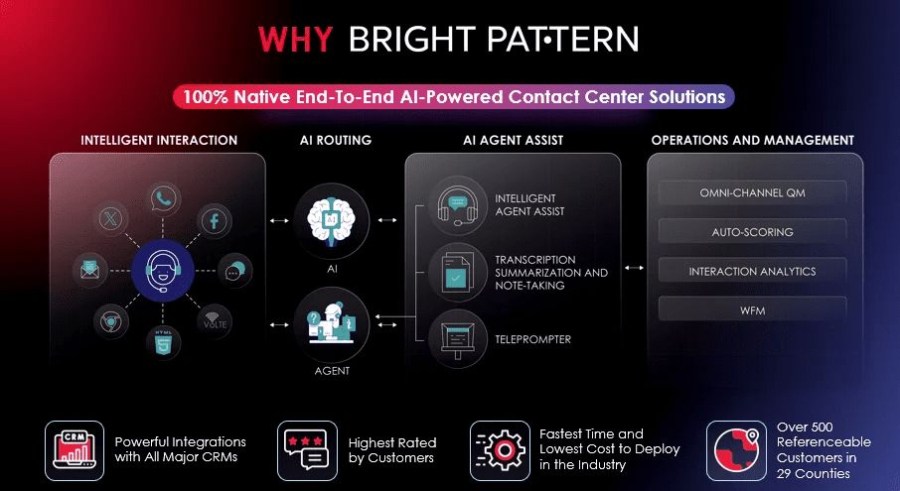
Bright Pattern leads the way in AI-powered contact center solutions, offering a platform designed to optimize both customer and agent experiences. With a strong focus on conversational AI, Bright Pattern helps businesses reduce wait times, automate repetitive tasks, and deliver personalized interactions across all communication channels.
Key features of Bright Pattern’s solution include:
- Omnichannel routing to connect customers seamlessly across voice, chat, email, and social media
- AI-powered chatbots and virtual assistants to handle high-volume queries efficiently
- Real-time agent assistance and AI-driven suggestions to improve response quality
- Analytics and reporting to monitor performance and customer satisfaction
- Easy integration with existing CRM and business systems for a unified workflow
Bright Pattern’s conversational AI call center solutions enable organizations to combine automation with human insight, creating a smarter and more responsive contact center environment.
2. Genesys
Genesys offers a cloud-based contact center platform with AI-driven automation and predictive routing. Their solutions focus on delivering personalized customer journeys while optimizing agent performance.
3. Five9
Five9 provides intelligent cloud contact center software that leverages AI to enhance customer engagement. Their platform includes virtual assistants, predictive dialers, and detailed analytics for better decision-making.
4. NICE inContact
NICE inContact specializes in cloud contact center solutions, integrating AI to improve customer interactions and streamline operations. Features include omnichannel support, workforce optimization, and AI-assisted analytics.
5. Cisco Contact Center
Cisco Contact Center solutions combine AI and cloud technology to deliver consistent, scalable support across multiple channels. Their platform emphasizes automation, intelligent routing, and robust analytics.
6. Avaya
Avaya’s contact center solutions offer AI-powered self-service options, chatbots, and advanced routing. The platform supports omnichannel interactions and provides actionable insights for better operational management.
7. Talkdesk
Talkdesk provides a cloud-based AI contact center that emphasizes automation and real-time intelligence. Features include AI virtual agents, workforce management tools, and analytics dashboards to track performance.
8. RingCentral Contact Center
RingCentral delivers AI-enabled contact center solutions that focus on seamless communication, automation, and personalized customer experiences. The platform integrates with major CRM systems and supports multiple channels.
9. 8x8 Contact Center
8x8 combines AI and cloud technology to offer flexible contact center solutions, including automated workflows, chatbots, and omnichannel support. Their tools help reduce operational costs and improve customer satisfaction.
10. Zendesk
Zendesk offers conversational AI call center tools that enhance customer support with automation, ticketing, and analytics. The platform helps businesses deliver faster responses and streamline agent workflows.
What Is a Conversational AI Call Center Solution?
Aconversational AI call center solutionis a combination of technologies that can understand, respond to, and act on customer requests using natural language. It can work over voice calls, chat, messaging apps, and even email, often as the first line of support before a human agent gets involved.
Instead of forcing callers through rigid phone trees ("Press 1 for support, 2 for sales"), conversational AI lets customers express their intent in their own words, such as:
- "I want to check my order status."
- "Please unblock my card."
- "I need to change my flight."
The system then interprets the request, pulls data from backend systems, and either resolves the issue automatically or routes the interaction to the right human agent with useful context attached.
How Conversational AI Call Center Solutions Work
Behind the scenes, a conversational AI solution brings together several components that work in real time to understand and serve customers.
1. Speech Recognition and Text Channels
For voice calls, the solution usesautomatic speech recognition(ASR) to convert spoken words into text. For chat or messaging, it simply takes the text directly. This unified text format becomes the input for the AI engine.
2. Natural Language Understanding (NLU)
Next comesnatural language understanding(NLU). This component identifies:
- Intent— what the customer is trying to achieve (for example, track order, reset password, update address).
- Entities— key details like dates, order numbers, product names, or locations.
- Sentiment— whether the customer sounds calm, confused, frustrated, or delighted.
Armed with this information, the system chooses the best next action.
3. Dialogue Management
Dialogue managementkeeps the conversation on track. It determines how to respond, what to ask next, and when to transfer to a human. It also remembers context, so the system can handle multi-turn conversations such as:
- Customer: "I want to change my address."
- AI: "Sure, is this for your billing or shipping address?"
- Customer: "Shipping."
- AI: "Got it. What is your new shipping address?"
4. Integrations With Your Systems
The most powerful conversational AI call center solutions do not operate in isolation. They integrate with:
- CRMplatforms to pull customer history and preferences.
- Order managementsystems to track deliveries and returns.
- Billing and paymentsystems for invoices and payments.
- Ticketingtools to create and update support cases.
This allows the AI to do more than answer questions; it can actuallycomplete taskson behalf of the customer.
5. Natural Language Generation and Voice
Once an action is decided, the system generates a clear response. For voice calls, it usestext-to-speech(TTS) to speak naturally, often with human-like intonation. For chat, it returns text that feels conversational and on-brand.
Key Benefits of Conversational AI in Call Centers
When conversational AI is thoughtfully designed and integrated, call centers see measurable gains across efficiency, service quality, and employee experience.
1. Faster Service and Shorter Wait Times
Conversational AI can handle many routine requests instantly. Instead of waiting in a queue, customers get:
- Immediate self-servicefor common needs such as balance checks, order status, or password resets.
- Smart triagethat routes more complex issues to the right agent the first time.
- 24/7 availabilityso customers get answers even outside business hours.
2. Higher First-Contact Resolution
Because AI systems can access multiple backend systems instantly, they can often solve issues on the first interaction. And when a human is needed, the AI can:
- Gather details in advance, such as account verification and problem description.
- Pass the full context to the agent, so customers do not have to repeat themselves.
- Suggest solutions or next best actions to the agent, speeding up resolution.
3. More Productive, Less Stressed Agents
When AI handles repetitive tasks, agents can focus on conversations where empathy and judgment really matter. That leads to:
- Reduced handle timeon many calls thanks to pre-gathered context and suggested responses.
- Less burnoutfrom repetitive interactions like balance inquiries or address changes.
- More fulfilling workas agents concentrate on complex, relationship-building conversations.
4. Consistent, On-Brand Customer Experience
Conversational AI delivers the same level of quality every time. It never forgets a script update and never ad-libs off-brand messages. This consistency shows up in:
- Standardized greetings, disclosures, and compliance language.
- Accurate answers drawn from a single, centralized knowledge base.
- Uniform service levels across regions, languages, and time zones.
5. Actionable Insights From Every Interaction
Every AI-powered conversation can be captured, transcribed, and analyzed at scale. This gives leaders a rich source of data to improve both operations and products.
- Spot common pain points and reasons for contact.
- Identify gaps in knowledge bases or processes.
- Track sentiment trends across products, regions, or campaigns.
6. Scalable Support at a Predictable Cost
Unlike traditional staffing models, conversational AI can absorb spikes in volume without dramatically increasing costs. This is especially valuable during:
- Product launches and promotions.
- Seasonal peaks and holiday periods.
- Unexpected incidents or service disruptions.
Before and After: The Conversational AI Impact
The table below shows how experiences typically transform once conversational AI is added to the call center mix.
Area | Traditional Call Center | With Conversational AI |
Customer wait time | Long queues during peak hours | Instant self-service for common requests |
Routing | Menu-based, often confusing IVR trees | Intent-based routing from natural language |
Agent workload | High volume of repetitive calls and chats | Routine tasks automated, focus on complex issues |
Service availability | Limited to staffed hours | Always-on digital support channels |
Quality consistency | Varies by agent experience and training | Standardized, policy-compliant responses |
Insights | Sample-based QA and analysis | Full-transcript analytics and trend detection |
Common Use Cases for Conversational AI in Call Centers
Conversational AI can add value across industries and departments. Here are some high-impact use cases that many organizations start with.
Customer Service and Support
- Order status and shipment tracking.
- Billing inquiries and payment confirmations.
- Password resets and account unlocks.
- Scheduling, rescheduling, and appointment confirmations.
- Basic troubleshooting and how-to guidance.
Sales and Up-Sell
- Qualifying inbound leads before handing to sales.
- Recommending relevant products or upgrades.
- Answering pre-purchase questions 24/7.
Proactive Notifications
- Shipping and delivery alerts with self-service options.
- Payment reminders that allow instant action.
- Service outage updates with estimated resolution times.
Internal Helpdesks
Conversational AI is not limited to customer-facing teams. Internal IT and HR helpdesks can also benefit from automated handling of:
- Common IT issues such as password resets or software access.
- Policy questions and HR FAQs.
- Employee onboarding steps and guidance.
Key Features to Look For in a Conversational AI Call Center Platform
Not all platforms are created equal. When evaluating conversational AI solutions for your call center, look for capabilities that support both performance and long-term flexibility.
1. Omnichannel Support
Customers expect a unified experience whether they call, chat, or message. Your solution should support:
- Voice, web chat, and mobile messaging.
- Consistent conversation flows across channels.
- Shared context so customers can switch channels without starting over.
2. Strong Natural Language Understanding
High-quality NLU is critical to understanding a wide range of phrasing and accents. Look for:
- Support for your key languages and regions.
- Customizable intents and entities for your business.
- Continuous learning from real interactions.
3. Deep Integrations and Automation
The real power of conversational AI comes from its ability toact, not just answer. Seek solutions that integrate smoothly with your existing ecosystem:
- CRM, ticketing, and knowledge base tools.
- Order, inventory, and billing systems.
- Authentication and identity services.
4. Agent Assist and Co-Pilot Tools
A modern conversational AI platform should help your agents in real time, not replace them. Agent assist capabilities might include:
- Live suggestions for answers and next steps.
- Automatic call summarization and note taking.
- Knowledge recommendations based on customer intent.
5. Analytics and Reporting
To keep improving, you need clear visibility into performance. Robust analytics should provide:
- Volumes by intent, channel, and time of day.
- Containment rates for automated flows.
- Customer satisfaction and sentiment trends.
- Routing accuracy and transfer rates to agents.
6. Low-Code or No-Code Conversation Design
Business teams often want to adjust flows quickly. Platforms that offer visual builders let non-technical stakeholders:
- Create and modify conversation paths.
- Update prompts and responses without code.
- Run A/B tests to optimize performance.
Implementation Blueprint: How to Get Started
Rolling out conversational AI in your call center does not have to be overwhelming. A structured approach keeps risk low and results strong.
Step 1: Define Clear Objectives
Start by deciding what success looks like. Examples of focused goals include:
- Reducing average handle time for a specific call type.
- Deflecting a percentage of routine inquiries to self-service.
- Improving first-contact resolution for a particular product line.
Step 2: Identify High-Impact Use Cases
Look at your call and chat data to find:
- High-volume, low-complexity interactions.
- Common questions that already have clear answers.
- Tasks that follow a consistent process every time.
These are perfect candidates for your first conversational AI flows.
Step 3: Map the Ideal Conversation Journeys
Design the experience from the customer’s point of view. For each use case, sketch:
- How the conversation starts (voice prompt, chat greeting, or proactive message).
- The questions the AI needs to ask to complete the request.
- The information it needs from your systems.
- When and how to offer a transfer to a human agent.
Step 4: Integrate With Core Systems
Partner with your IT and operations teams to connect the AI to relevant data sources. Make sure that:
- Security and privacy requirements are met.
- Access to customer profiles and history is available where needed.
- Actions such as updates, cancellations, or refunds are properly authorized and logged.
Step 5: Pilot, Learn, and Iterate
Launch your conversational AI with a limited set of flows or a subset of customers. Monitor:
- Completion and containment rates.
- Customer satisfaction scores for the AI channel.
- Transfer reasons when customers choose to talk to an agent.
Use these insights to refine prompts, add clarifying questions, and update your knowledge base.
Step 6: Scale and Expand
Once initial flows are performing well, expand gradually by:
- Adding new intents and capabilities.
- Extending to additional channels or regions.
- Empowering more teams to manage and optimize their own conversation flows.
Best Practices for Successful Conversational AI in Call Centers
To get the best results, it helps to adopt a few proven practices from teams that are already running mature conversational AI programs.
1. Keep Conversations Natural but Focused
People appreciate a conversational tone, but they value speed and clarity even more. Craft responses that are:
- Short and direct, with minimal jargon.
- Supportive and empathetic, especially in difficult situations.
- Transparent about what the AI can and cannot do.
2. Design for Smooth Human Handoffs
The handoff from AI to agent is a critical moment. Make it a strength, not a weakness, by ensuring that:
- Agents receive the full conversation transcript or summary.
- Key details like verified identity and issue type are clearly highlighted.
- Customers understand they are now speaking with a person who is already up to speed.
3. Start Simple, Then Add Intelligence
Instead of trying to automate every possible scenario at once, start with highly structured tasks and gradually introduce more open-ended capabilities. This phased approach lets you learn from real data while continuing to deliver value.
4. Involve Frontline Teams Early
Your agents know your customers and processes better than anyone. Involving them early helps you:
- Identify ideal use cases and conversation flows.
- Spot potential pitfalls or edge cases.
- Build trust and enthusiasm for the new technology.
5. Continuously Train and Optimize
Conversational AI is not a one-and-done project. Ongoing success comes from:
- Regularly reviewing interaction logs to find misunderstandings.
- Updating intents and entities as products and policies change.
- Refreshing your knowledge base with new content and clarifications.
Measuring ROI From Conversational AI Call Center Solutions
To demonstrate the value of conversational AI, you will want to track both efficiency and experience indicators. Common metrics include:
Operational Metrics
- Contact deflection and containment rate— the percentage of interactions fully handled by AI without human intervention.
- Average handle time— reductions driven by better triage and agent assist.
- Queue length and abandonment rate— improvements thanks to instant self-service.
- Staffing flexibility— the ability to handle peaks without proportional staffing increases.
Customer Experience Metrics
- Customer satisfaction (CSAT)after AI-powered interactions.
- Net Promoter Score (NPS)trends following implementation.
- Sentiment scoresfrom conversation analysis.
- Repeat contact rates— a proxy for first-contact resolution.
Employee Experience Metrics
- Agent satisfaction and engagement scores.
- Agent turnover and retention rates.
- Time spent on complex, high-value interactions versus routine tasks.
AI and Human Agents: Better Together
One of the most powerful aspects of conversational AI is how well it complements human talent. Rather than replacing agents, the best solutions free them from repetitive tasks so they can focus on what humans do best:
- Building trust and relationships.
- Handling exceptions and complex scenarios.
- Exercising judgment and creativity when the situation demands it.
When AI takes care of listening, transcribing, summarizing, and suggesting, agents can fully concentrate on the person on the other end of the line. That combination leads to faster resolutions, more personalized service, and a better experience for everyone involved.
Bringing Conversational AI to Your Call Center
Conversational AI call center solutions offer a practical, powerful way to transform customer service. By understanding natural language, connecting to your core systems, and working hand in hand with your agents, they help you:
- Delight customers with instant, always-on support.
- Empower agents to do higher-value, more meaningful work.
- Gain clear visibility into customer needs and trends.
- Scale operations smoothly and cost-effectively.
The most successful programs start with clear goals, focused use cases, and a commitment to continual improvement. With that foundation, conversational AI becomes more than a new tool in your stack; it becomes a strategic advantage that turns every interaction into an opportunity to serve better, sell smarter, and build long-term loyalty.
